You’re standing at the bin with two containers and an important question you don’t know the answer to: Which waste stream do the contents go into? A leaking solvent bottle and a blood-soaked wipe both feel dangerous, but they’re dangerous in very different ways. One threatens you with chemistry. The other threatens you with biology. Mix them up and you risk a failed audit, a fine, or an exposure that puts your staff in harm’s way. Read on to discover how to tell hazardous waste and biohazardous waste apart, handle the cases where they overlap, and understand exactly what’s at stake when the label is wrong.
The Core Difference
Here’s the easiest way to think about the difference: Hazardous waste poses a chemical danger, while biohazardous waste poses a biological or infectious danger.
This difference isn’t academic. The two categories fall under different regulations, move through different systems, and get disposed of through different channels. Getting the category right is the first step in every compliant disposal decision you make.
What Is Considered Hazardous Waste
So what is considered hazardous waste in a lab setting? Under the Resource Conservation & Recovery Act (RCRA), the four telltale characteristics are:
- Ignitability: It catches fire easily, like many spent solvents.
- Corrosivity: It’s strongly acidic or basic.
- Reactivity: It’s unstable and can explode or release toxic gas.
- Toxicity: It’s harmful or fatal when ingested or absorbed.
Common examples of RCRA hazardous waste include spent solvents, expired reagents, certain disinfectants, heavy metals, and alcohol-based products in bulk. The EPA regulates these wastes under RCRA, and the Department of Transportation governs how they move. Knowing what RCRA hazardous waste is keeps this whole waste stream compliant. At Clym Environmental, our hazardous waste management team handles the job end to end.
What Counts as Biohazardous Waste
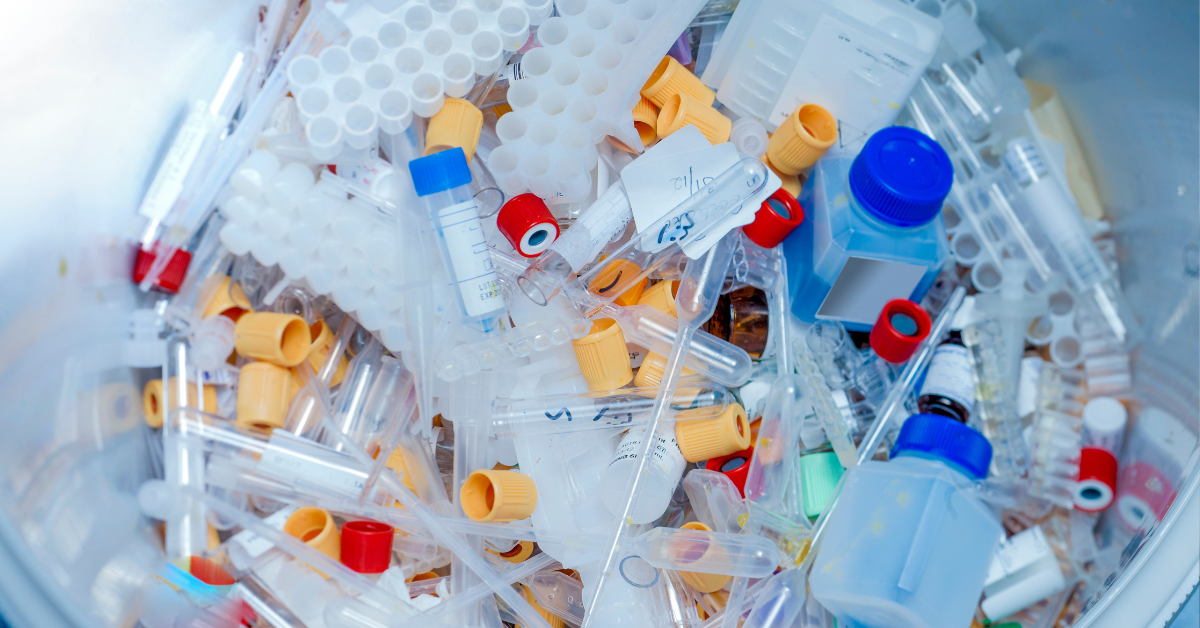
Biohazardous waste is a different story; it’s any material contaminated with infectious agents, which is why you’ll hear it called infectious, biomedical, biological, or red bag waste.
Typical lab examples include:
- Blood and other potentially infectious materials (OPIM)
- Sharps, such as needles, scalpels, and broken glass
- Cultures and microbiological waste
- Pathological and animal tissue
The lead regulator here is the Occupational Safety & Health Administration (OSHA), through its Bloodborne Pathogens Standard, alongside state health and environmental agencies. How to dispose of biohazardous waste depends on the specific material, but most of it flows through biological waste disposal, while sharps and red bag streams often route through dedicated medical waste disposal programs.
Hazardous vs. Biohazardous at a Glance
| Factor | Hazardous Waste | Biohazardous Waste |
|---|---|---|
| Type of risk | Chemical | Biological or infectious |
| Common sources | Solvents, reagents, disinfectants | Blood, sharps, cultures, tissue |
| Lab examples | Spent solvents, heavy metals | OPIM, needles, animal tissue |
| Governing regulation | EPA under RCRA, DOT for transport | OSHA Bloodborne Pathogens, state agencies |
| Container and labeling | Compatible chemical containers, hazard labels | Red bags, rigid sharps containers, biohazard symbol |
| Disposal method | Treatment, incineration, permitted landfill | Autoclave, incineration, regulated treatment |
How to Classify the Waste in Front of You
When you’re unsure of what kind of waste the waste in front of you is, work through three quick questions at the bin:
- Does it pose a chemical hazard, i.e., is it ignitable, corrosive, reactive, toxic, or EPA-listed?
- Is it contaminated with potentially infectious material such as blood, tissue, or cultures?
- Is it both?
If only the first is true, you have hazardous waste. If only the second is true, you’re into the biological stream, and determining how to dispose of biohazardous waste means following your facility’s red bag and sharps protocol. If both are true, you have a dual-regulated stream that demands extra care.
When in doubt, segregate and verify. Setting a container aside for a minute is better than guessing and creating a violation.
When Waste Is Dual-Regulated
This is where facilities can slip. Some waste is simultaneously hazardous and biohazardous, which means it must satisfy both RCRA and OSHA or state rules. Examples include:
- Trace chemotherapy waste
- Formalin or chemically fixed specimens
- Cultures preserved in a hazardous chemical
A single label won’t cover these streams, and treating them as one type or the other creates exposure on both fronts. A specialized partner matters most here. At Clym, our mixed waste disposal service is built for exactly these dual-regulated materials.
Why Getting the Classification Right Matters
Misclassification carries a cost. Send an infectious material down a chemical path, or the reverse, and you can trigger:
- EPA or RCRA violations
- OSHA citations
- Failed audits and fines
- Serious exposure risk to your staff
Each agency owns a different piece: The EPA and RCRA cover chemical hazard, OSHA covers infectious risk, the DOT covers transport, and state agencies fill in the rest. Knowing who governs what keeps your program defensible.
Building a Segregation System That Prevents Mistakes
The best way to avoid a classification error is to make the right choice the easy choice. That means:
- Correct containers and labels at the point of generation
- Clear signage at every collection point
- Regular staff training on what goes where
- A disposal partner who can manage every stream
When your system does the sorting for people, mistakes drop. Clym’s safety consulting team can help you design segregation and labeling that holds up under an audit.
Managing Waste With Confidence
The difference comes down to one sentence: hazardous waste is a chemical danger, and biohazardous waste is a biological one. When a container leaves you unsure, run the three-question framework, and when doubt remains, segregate and verify.
Need a second set of eyes on your waste streams? Reach out to Clym’s EHS specialists for help classifying and managing every category with confidence.